
Treatments & what works
Hair Growth Serums: Ingredients, Evidence and How to Choose
Compare hair growth serums by ingredients, study quality and purpose. Learn what labels can tell you, how to use a serum and when hair loss needs assessment.
By Maša
Published 10 min read

The short version
Hair growth serums include conditioning products, cosmetic scalp formulas and medicinal topicals with different purposes. Match each claim to the tested formula, population and measured outcome. Ingredient or laboratory findings do not establish what every finished serum will do, and unexplained or worsening loss deserves assessment.
A hair growth serum can mean a conditioning product, a cosmetic scalp treatment or a medicinal topical. The word "serum" tells you little about whether it changes hair growth. Before choosing one, check where it goes, what outcome it promises and whether the evidence concerns that finished formula. A smoother ponytail and a higher scalp hair count are different results, even when both appear under a "thicker hair" headline.
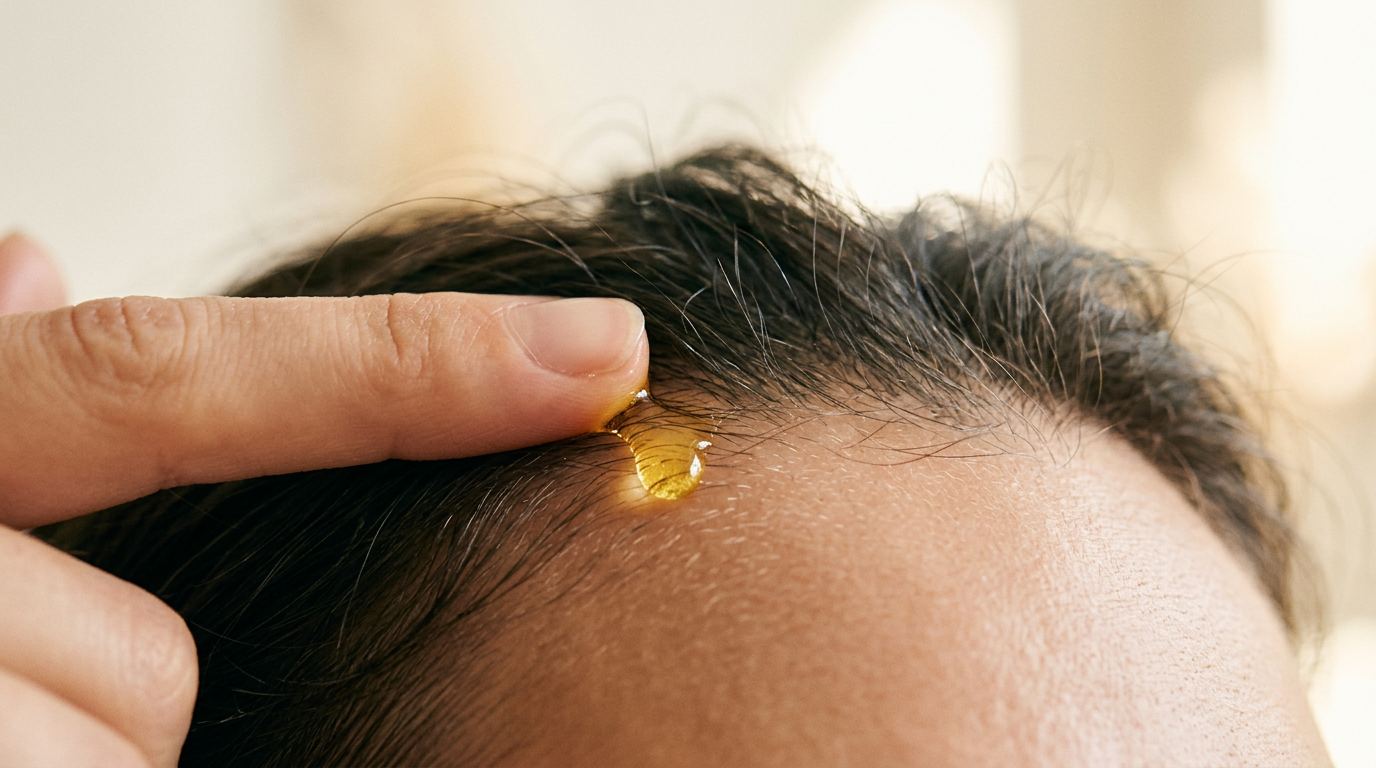
What is a hair growth serum supposed to do?
Read the application instructions before comparing ingredients. They help separate products with different purposes.
| Category | Where it is used | What to evaluate |
|---|---|---|
| Conditioning or styling serum | Usually through the lengths and ends | Smoothness, manageability and the appearance of the hair you already have |
| Cosmetic scalp serum | On scalp skin, according to its label | The stated scalp or hair-appearance outcome and evidence for that formula |
| Medicinal topical treatment | On the scalp, following its medicine instructions | Evidence for the active treatment in your diagnosed type of hair loss |
A scalp application does not establish that a cosmetic serum produces regrowth. Equally, a conditioning serum can do its intended job without changing what happens at the root. Choose the category that matches the problem you want to address.
Bhat and colleagues' review of female pattern hair loss describes gradual follicle shrinking and progressively finer hair. A styling product's effect on the visible lengths is a separate question from treating that process.

Does reaching the follicle mean a serum works?
No. Delivery and a useful clinical result are separate things to demonstrate.
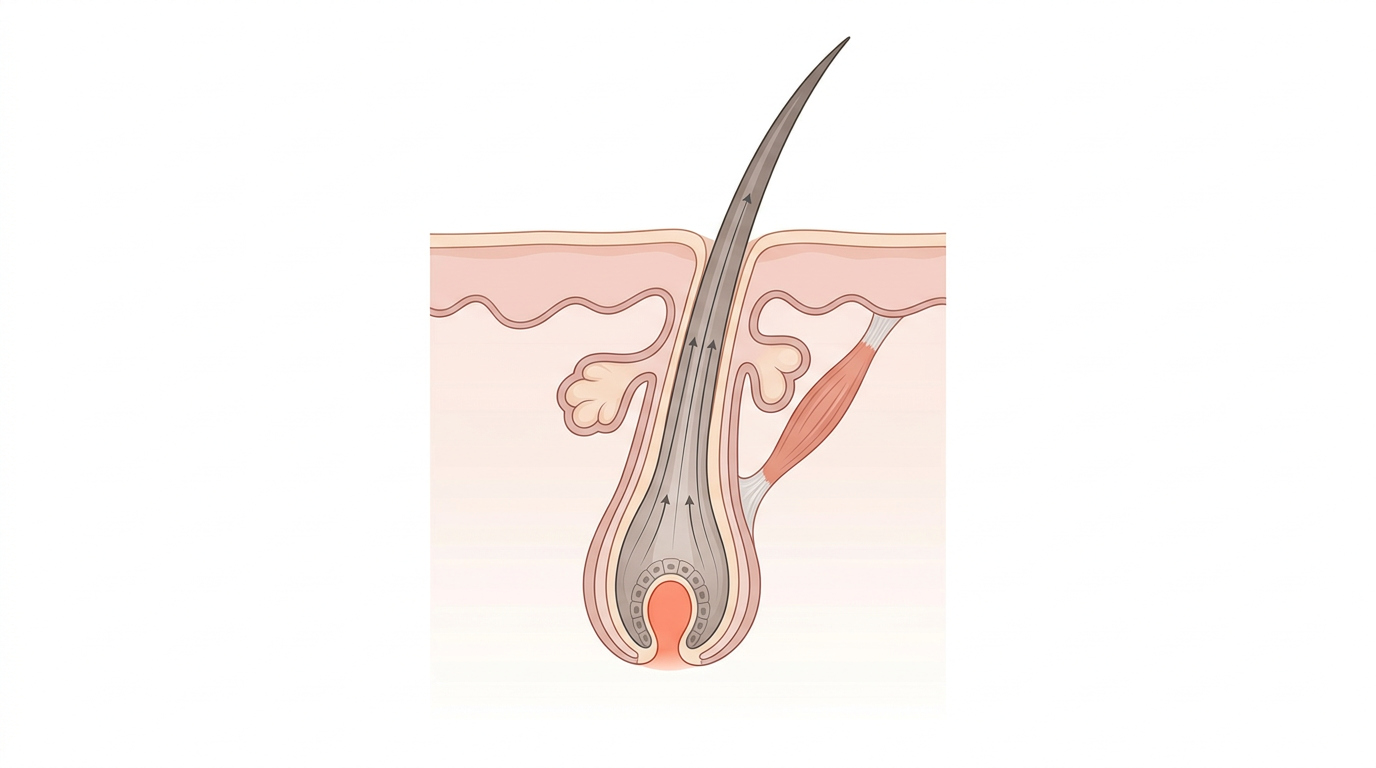
Lademann and colleagues' 2006 delivery study found longer storage of tested substances in hair follicles than in the outer skin layer. It investigated a delivery reservoir, not whether a hair serum increased density or reduced shedding. Its findings do not establish a massage technique or a waiting time before shampooing for every product.
When a label talks about "deep penetration", ask what reached the target and what happened afterwards. A formulation needs evidence for its claimed outcome; a diagram showing a route into the skin cannot supply that evidence.
What evidence do common serum ingredients have?
The evidence differs by ingredient, combination and type of hair loss. An ingredient list is a starting point for checking a claim.
Peptides and red clover
Peptides are a varied category. One studied combination pairs acetyl tetrapeptide-3 with red clover flower extract. Loing and colleagues recruited 30 volunteers for a four-month randomized, placebo-controlled trial. The treated group's ratio of growing to resting hairs increased 46% over its starting value; the placebo group's ratio fell 33%. That is a growth-phase ratio, not 46% more hair.
The paper does not state the volunteers' sex, and the small trial tested the pair in a particular lotion. Its result cannot be assigned to the peptide alone or to every serum containing either ingredient.
The Lucas Meyer Cosmetics technical file also reports cultured human scalp follicles growing longer with the peptide over eight days, using six treated follicles. This is relevant laboratory evidence, separate from the trial on heads. It does not measure visible regrowth in women using a finished serum.
Caffeine
Fischer and colleagues studied follicles from male and female donors in culture in 2014. Caffeine increased hair-shaft elongation and prolonged the growing phase; female follicles showed greater sensitivity. These were isolated follicles over five days. The finding explains interest in caffeine, but does not predict the result of a particular leave-on product.
Saw palmetto
Evron and colleagues' systematic review included oral and topical preparations containing saw palmetto. The authors found positive findings but a lack of robust, high-quality data. Mixed routes and formulations matter: a result from a swallowed preparation cannot substantiate a scalp serum's claim.
Biotin
A biotin name on the label does not answer whether a topical formula works. Evidence about correcting deficiency with oral biotin addresses a different route and question. For a biotin-containing serum, ask for evidence on the topical formulation and the outcome being advertised.
Minoxidil
Minoxidil is a medicinal treatment, and its trial results describe that medicine. Bergfeld and colleagues randomized 404 women with female pattern hair loss to minoxidil foam or its vehicle. At 24 weeks, the minoxidil group had 9.1 more hairs per square centimetre than the vehicle group. This is evidence for the studied treatment in women with that diagnosis, not a promise for another serum.

Which formulation details deserve a closer look?
Look for clear instructions, a full ingredient list and information that connects the formula to its evidence. A named complex is useful only if you can identify what was tested. If the concentration is undisclosed, record that as an unanswered question rather than guessing from the label.
Avoid automatic ingredient blacklists. In Friedman's 2002 report of patients patch-tested after reactions to minoxidil solution, propylene glycol was the allergen in most cases. That selected patient group does not show that everyone should avoid it. The active itself can also cause allergy.
Your previous reactions are more useful than a universal rule about alcohol, fragrance or texture. A rich formula is not automatically unable to reach skin, and a watery formula is not automatically effective. Persistent itching, burning or scaling deserves assessment, including whether a product is responsible.

Who should get a hair-loss assessment before choosing a serum?
If your loss is unexplained, persistent or getting worse, find out its cause before you treat a serum's label claim as a plan. A widening part can be upsetting, but it does not tell you which ingredient to choose.
Bhat's review describes female pattern hair loss as progressive thinning, usually over the crown and upper scalp. It also explains why assessment must distinguish it from shedding conditions and other forms of loss. The history, examination and sometimes scalp magnification help make that distinction.
Tell your clinician when the change began, whether it is shedding or gradual thinning, and about recent illness, childbirth or medication changes. Sudden patches, pain, burning, marked scaling or a changing hairline warrant timely review rather than repeated cosmetic purchases.
For hair loss treatment for women, the diagnosis determines which options deserve consideration. A serum is one category within that wider decision. Early assessment need not mean starting a serum; it means finding out what you are trying to change.
What should you check at 30, 60 and 90 days?
Use these as practical check-ins, not a biological timetable that every serum must follow.
During the first month, note whether the product is comfortable, whether you can follow its instructions and whether it leaves residue you dislike. Do not interpret burning or worsening symptoms as evidence that it is working. Smoother hair can count as a conditioning result without demonstrating new growth.
At around two months, compare any record with the outcome you chose at the start. Use the same parting, lighting and camera angle for photographs. Changes in styling can alter scalp visibility, so an isolated photograph cannot settle whether density changed.
At three months, review the product's own evidence and the follow-up plan agreed for your type of loss. Loing's trial measured its main result at four months; Bergfeld's assessed women at 12 and 24 weeks. Neither creates a universal deadline for cosmetic serums.
A study's endpoint is not an instruction to wait through progressive loss or irritation. Agree on a review date with your clinician when treatment is involved, and seek earlier review for new symptoms.
How can you check whether a serum claim fits its evidence?
Match the claim to the kind of evidence supplied. Lademann's study measured storage of tested substances in hair follicles, and Fischer's measured isolated follicles in culture; neither measured density or shedding with a finished serum.
| Evidence offered | What it can tell you | What to check next |
|---|---|---|
| Finished-formulation human trial | What happened with the tested product under its study conditions | Same formula, population, comparator, duration and measured outcome? |
| Ingredient or combination trial | What happened with that ingredient preparation or blend | Same concentration and vehicle? Was the ingredient tested alone? |
| Laboratory or cultured-follicle experiment | A possible biological action in that model | Has a human study tested the proposed benefit? |
| Customer satisfaction survey | What users reported feeling or noticing | Was the claim about satisfaction, or does the wording imply measured growth? |
Then examine the result itself. Hair counts, hair width, shedding and growth-phase ratios measure different things. "Improved from baseline" compares people with their own starting point; a comparison against the product's base asks a different question.
Check whether the participants resemble you. Men, women, people with patchy autoimmune loss and people with pattern thinning are not interchangeable populations. "Tested" also needs an object: the complete bottle, one ingredient, or tissue exposed to an ingredient in a dish?
For example, a bottle promising a denser part should provide an outcome relevant to density. A survey about softer hair does not answer that question, even if nearly everyone enjoyed using the product. Ask for the actual study summary, including how many people completed it and what the comparison group used.
A formula containing a studied ingredient can still be worth considering for its stated cosmetic purpose. Ask what the supplied evidence shows for that stated purpose, in that formula. An ingredient's appearance in a paper does not answer it.
If the study cannot be identified, leave the claim unconfirmed. There is no need to invent a favourable or unfavourable verdict from the packaging.
How should you apply a scalp serum?
Follow that product's instructions for the application site, amount, frequency and whether the scalp should be wet or dry. Styling-serum directions and medicinal-treatment directions serve different products.
For a scalp product, part the hair so you can reach the intended skin rather than depositing everything on the lengths. Follow any stated drying, rinsing or hand-washing instructions. Do not borrow a drop count, massage duration or contact time from a different bottle or from a delivery experiment.
Before combining a cosmetic scalp serum with a medicinal topical, ask a pharmacist or clinician whether the pairing and timing are appropriate. Keep a record of what you start and when. If symptoms appear, that record helps the discussion about what to stop or change.
How does a serum fit into your existing routine?
Give each product a clear purpose. A conditioner can help you manage the lengths; a scalp product needs its own reason for being there. Do not add several new products at once if you want to judge which one you tolerate and whether it meets your goal.
Keep washing practical for your scalp and the product's instructions. Repeatedly adding exfoliants, oils and "growth boosters" makes the routine harder to assess. A flaky or sore scalp needs attention in its own right, rather than another serum layered over it.
Treat supplements as a separate decision about dietary or medical need. Their presence in a hair-care routine does not supply missing evidence for a topical product.
Before committing to a bottle, write down its purpose, the evidence that supports that purpose and when you will reassess it. If those answers remain vague, the next useful step is to clarify the claim or the cause of the loss.
Key terms
- follicle
- The growth site within the scalp that produces a hair.
- vehicle
- The base formulation used as a comparison in a treatment trial.
- growth-phase ratio
- The ratio of growing hairs to resting hairs, which is different from a hair count.
Quick answers
Does evidence for one ingredient prove a serum works?
No. Check whether the study tested the same ingredient combination, concentration, vehicle, population and outcome as the claim for the finished formula.
Does a better growth-phase ratio mean the same percentage more hair?
No. A growing-to-resting-hair ratio and a hair count measure different things.
Should every serum be judged after the same waiting period?
No. Review the product's own evidence and any follow-up plan for your type of hair loss. A study endpoint is no reason to wait through progressive loss or irritation.
About Maša
Maša writes the Medyko blog’s hair guides together with the Medyko team. Every guide is researched against published studies and edited by the team before it goes live.
How we research and write our articlesSources
- 1.Female Pattern Hair Loss-An Update — Indian Dermatology Online Journal, 2020
- 2.Hair follicles - a long-term reservoir for drug delivery — Skin Pharmacology and Physiology, 2006
- 3.A new strategy to modulate alopecia using a combination of two specific and unique ingredients — Journal of Cosmetic Science, 2013
- 4.Differential effects of caffeine on hair shaft elongation, matrix and outer root sheath keratinocyte proliferation, and transforming growth factor-β2/insulin-like growth factor-1-mediated regulation of the hair cycle in male and female human hair follicles in vitro — British Journal of Dermatology, 2014
- 5.Natural Hair Supplement: Friend or Foe? Saw Palmetto, a Systematic Review in Alopecia — Skin Appendage Disorders, 2020
- 6.A Phase III, Multicenter, Parallel-Design Clinical Trial to Compare the Efficacy and Safety of 5% Minoxidil Foam Versus Vehicle in Women With Female Pattern Hair Loss — Journal of Drugs in Dermatology, 2016
- 7.Allergic contact dermatitis to topical minoxidil solution: etiology and treatment — Journal of the American Academy of Dermatology, 2002
This article is general information, not medical advice. If you’re worried about hair loss or your health, talk to a doctor or a dermatologist.
